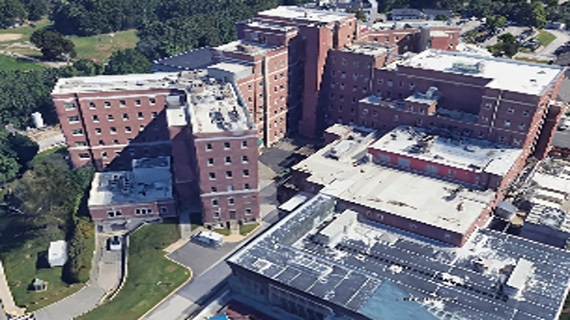
Triple C provided comprehensive Electronic Health Record Modernization (EHRM) infrastructure upgrades at the Providence VA Medical Center through 100% Construction Documents. The 644,381-SF project spans the main campus, remote clinics, multiple existing buildings and technical spaces, an expansion of the Building 4 Main Computer Room (MCR), two new telecommunications room towers at Building 1, and associated site infrastructure. The design prepares the station for the Cerner rollout while preserving clinical operations and providing capacity for planned growth.
As Prime A/E, Triple C coordinated a multidisciplinary modernization of mission-critical IT, power, cooling, security, life-safety, architectural, structural, and site systems. The design replaces copper with CAT6A, establishes geographically diverse A/B fiber pathways, adds new racks and cable infrastructure, and provides 2N power, modular UPS, redundant cooling, and clean-agent fire suppression for critical technology spaces. Occupied-facility phasing, temporary redundant connectivity, off-hours cutovers, and pre-commissioning strategies were incorporated to maintain uninterrupted hospital operations during migration and future construction.
Key Project Elements:
- Main Computer Room expansion and two new telecommunications room towers
- CAT6A copper replacement and geographically diverse redundant A/B fiber backbone
- New racks, patch panels, cable tray, grounding, bonding, labeling, testing, and firestopping
- 2N electrical power, modular UPS systems, redundant busway, and emergency power-off controls
- Redundant MCR cooling with CRAC units, raised-floor distribution, and hot/cold aisle organization
- VRF and dedicated DX cooling for telecommunications room stacks and towers
- PACS, intrusion detection, CCTV, controlled site gates, fire alarm, and clean-agent suppression
- Architecture, interiors, structural engineering, and site/civil improvements
- PSRDM critical-facility blast hardening and progressive-collapse design criteria
- LiDAR scanning, underground GPRS, geotechnical investigation, ACM/lead surveys, and electrical load monitoring
- Occupied-facility phasing, ICRA coordination, temporary services, and off-hours cutovers
- Commissioning requirements, functional performance testing, TAB verification, training, and systems manuals
- 100% construction documents, cost estimating, deductive alternates, and CLIN-based procurement strategy
- Operational continuity planning protecting legacy systems, clinical services, and hospital access
Client:
Department of Veterans Affairs | Providence VA Medical Center
Year:
2023-2026
Sq Ft
644,381 SFServices Provided
Project Management, Architecture, Interior Design, Structural Engineering, Mechanical Engineering, Electrical Engineering, Fire Protection, Telecommunications, Security, Site/Civil Engineering, Existing Conditions Surveys, LiDAR and GPRS, Geotechnical and Hazardous Materials Investigation, Cost Estimating, Phasing, Commissioning Planning